
Fractional CMO Services: The Full-Time Shift

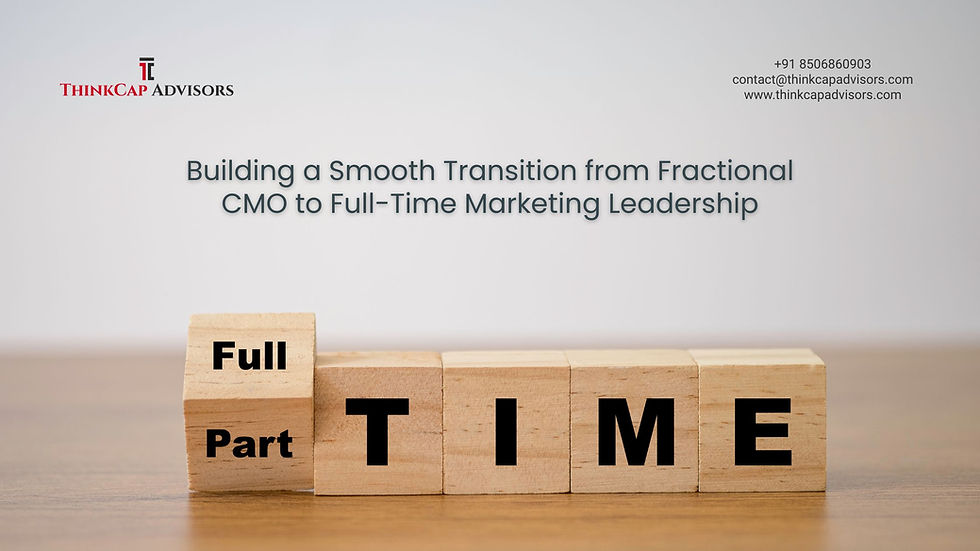
Every fractional CMO engagement that works eventually reaches the same decision point. The company outgrows the model that got it here. That's not a failure of the fractional approach — it's the logical conclusion.
A fractional CMO is brought in to build the marketing function, not to run it forever, and the day a founder starts wondering whether it's time for a full-time hire is usually the day the fractional engagement has done its job.
The harder question isn't when to make that call. Founders and leadership teams often feel that shift long before anyone points it out to them. The harder question is whether the handover will be smooth or scrambled, and that depends entirely on how the engagement was run in the months before the transition, not on the transition itself.
Signals That It's Time to Transition, Not Just Renew
There isn't one trigger. It's usually a combination of three things showing up around the same time, and it's the combination that matters more than any single number.
The business has scaled past what a part-time model can absorb. Revenue crossing roughly the $5 million mark is typically the first clear indicator — not because of the number itself, but because of what tends to come with it: more senior stakeholders weighing in on marketing decisions, more campaigns running in parallel, and a pace of decision-making that a two or three-day week engagement starts to struggle to keep up with.
Revenue on its own is a weak signal, though. In our experience, most companies don't fully commit to a full-time CMO until annual revenue is in the $7 million to $10 million range; it's the combination of revenue, headcount, and decision complexity climbing together that tends to force the question.
There's a counter version of this signal worth naming: a marketing engine running well is not, by itself, a reason to stay fractional. When campaigns, reporting, and channels start operating close to autopilot, it often means there is enough happening and it genuinely needs someone watching it five days a week instead of two or three.
A smoothly running function can still be an understaffed one at the leadership level.
The strategic groundwork is done, and now it's an execution problem. Early on, a fractional CMO's job is largely about getting the fundamentals right, i.e., building a GTM strategy, fixing a funnel that wasn't converting, getting CRM and marketing automation to actually work as a system rather than a collection of disconnected tools.
Once that foundation is in place and campaigns are running on a steady, repeatable cadence, the nature of the job changes. It stops being about building and starts being about managing scale. This shift from architect to operator is usually the point where the case for a full-time leader becomes easier to make than the case for adding more fractional hours.
The fractional relationship itself has run its course. This one is less about the company's growth curve and more about fit, and it's the signal that's easiest to miss because it doesn't show up in a dashboard.
Over time, the thinking of the top leadership team and the fractional CMO can start to drift apart because priorities shift as a company matures and the people around the table change. At the same time, the internal marketing team that's been built often reaches a point where it no longer needs involvement of a fractional leader.
It needs full-time ownership of someone who's in the building every day, making calls in real time rather than in scheduled blocks.
What a Fractional CMO Should Leave Behind
The single biggest factor in whether a transition goes well isn't the transition plan itself — it's whether the groundwork for handover was laid from day one, not scrambled together in the final weeks once a full-time hire is already in motion.
That means marketing assets, campaign calendars, and social media calendars need to be documented in a form someone new can actually pick up and use, not just files scattered across whoever happened to create them.
It means playbooks exist in writing, including reasoning behind channel choices, past campaign results, what worked and what did not.
It means agency relationships, including digital and PR partners, are informed of the transition ahead of time rather than finding out about a leadership change secondhand, mid-project.
It means the CRM system and marketing automation platform come with a proper knowledge transfer on how the data is structured, what automations are running, and why certain workflows were built the way they were.
An engagement where none of this was done typically means the first month of a new full-time CMO's tenure gets spent reverse-engineering what already exists. The CMO will spend time figuring out why a campaign was built a certain way, chasing down agency contacts, untangling a CRM with no documentation behind it.
An engagement where this was treated as ongoing hygiene means the new CMO can spend their first month deciding what to build next rather than playing a catch-up game.
What Happens Next: Three Realistic Paths
When the transition point arrives, there are generally three ways it plays out, and which one fits depends less on preference and more on what's actually missing.
The company hires a full-time CMO and restructures the fractional relationship. This is the most obvious path, and it's what most people picture when they think about graduating from a fractional model. Done well, the fractional CMO's documentation and systems become the new hire's starting point rather than something they have to piece together.
The fractional engagement gets renegotiated instead of being replaced. Sometimes what's actually missing isn't full-time seniority — it's full-time time. If the strategy is sound, the team is capable, and the gap is purely about hours in the week, the existing fractional relationship can be restructured for a greater time commitment and a commercial arrangement. This path is often overlooked simply because "hire a full-time CMO" is the default assumption.
Someone internal steps up. Part of a fractional CMO's job, done well, is mentoring the internal team — which means there's a real possibility that someone in the team has grown into the role over the course of the engagement.
The signs worth watching for are less about title and more about behaviour: someone who's already making sound calls, who understands the reasoning behind the marketing strategy well enough to defend it in a room. When that person exists, the fractional CMO is best-positioned to recognize it and help identify that internal successor.

How ThinkCap Approaches the Handoff
We build every fractional CMO services engagement on the assumption that it might eventually end — which is a different way of running things than treating the handover as a future problem to solve later.
All the work our fractional CMOs produce is structured to be download-ready from day one: marketing assets, CRM systems, agency relationships, and content are documented and stored properly as they're created.
Alongside that, we identify an internal team member early in the engagement to act as a shadow to the fractional CMO- someone who sits close enough to the day-to-day work to step in on an interim basis if the need arises.
There's one more advantage that comes from being part of a network rather than working with an individual practitioner: because ThinkCap works with a pool of fractional leaders, there's often a real possibility that a fractional CMO from within that network can step in and take on greater time and responsibility — which can remove the need to search for a full-time hire, and because both CMOs are part of the same network, the handover between them tends to be considerably smoother than a handover to someone coming in cold.
Article Written By: Rahul Iyer | Fractional CMO & Lead Consultant


Comments