
Why Execution Matters As Much As Strategy For A Fractional CMO

Most companies bring in a fractional CMO expecting a strategy. They expect positioning frameworks, a go-to-market plan, a brand architecture document, a slide deck that explains how the product should be perceived in the market. What they often don't expect — and what actually determines whether the engagement moves revenue — is how much of a fractional CMO's calendar should be spent building, not planning.
Strategy tells a company where to go. Execution is what gets it there. For a fractional CMO working with small teams, e.g., B2B SaaS company without a marketing department or a mid-size firm between hires, the founder-led business that has never had a CMO at all, execution is not a nice to have but critical for success.
Strategy on Paper Doesn't Move Revenue. Assets Do.
A positioning document is a hypothesis until it's expressed somewhere a buyer can actually see it. For a B2B SaaS company, that means the website has to say what the strategy says — not generically, but in copy and structure that reflect the sharpened narrative on the homepage, the product pages, and the pricing page.
It means case studies exist that prove the claims the strategy makes. Built around real customer outcomes rather than generic testimonials. It means white papers exist that establish the category authority. It means the sales team has one-pagers, competitive battle cards, and pitch decks that translate the brand story into something they can use in a call today, not something promised for next quarter.
The full portfolio a fractional CMO has to include execution pointers:
Website copy and structure, aligned to the positioning
Case studies and customer proof points, built for the sales cycle they're meant to support
White papers and category-defining content, used as lead magnets and authority signals
Social media content, especially LinkedIn thought leadership rather than company updates alone
Press releases, framed around how the company wants to be known, not just what happened
Sales enablement tools — battle cards, ROI calculators, demo scripts — that the sales team actually uses
A fractional CMO who hands off a strategy deck and leaves asset creation to whoever is available — a junior marketer, an intern, an agency, is handing off the part of the job that determines whether the strategy survives contact with the market.
Marketing assets are not downstream deliverables that follow the strategy. They are the strategy, made visible.
We have written in more depth before about how this plays out page by page — see The Role of a Fractional CMO in Creating Marketing Assets for B2B SaaS.
Campaigns Need a Person Watching Them, not a Quarterly Review
Strategy documents get reviewed quarterly. Campaigns don't wait that long to succeed or fail. A paid channel with rising acquisition cost, a content series that isn't landing, a social account that's gone quiet for three weeks — these are things a fractional CMO only catches by staying close to the day-to-day performance of brand-building and lead-generation channels, not by scheduling a monthly strategy call.
This is also where the marketing calendar and the content calendar earn their keep — not as one-time deliverables handed over in week one, but as living documents the fractional CMO actively owns and adjusts.
What's publishing for organic SEO this week
What's going out on social, what article or blog is in the pipeline
What campaign is live and how it's tracking against plan
SEO — and Now GEO — Needs the CMO's Direct Hand
SEO used to be something a fractional CMO could reasonably hand to a specialist and check in on monthly. That has changed. As AI-powered search reshapes how buyers find and evaluate vendors, a company's visibility now depends on two overlapping disciplines: traditional SEO, which still governs how a page ranks in Google, and Generative Engine Optimization (GEO), which governs whether that same page gets surfaced, cited, or summarized inside an AI-generated answer.
These aren't the same skill practiced twice — they require continuous, hands-on judgement about content structure, technical implementation, and authority signals, regularly updated as search behavior itself keeps shifting with every core update.
This isn't work a fractional CMO can fully delegate and still claim ownership of the outcome. Driving SEO and GEO strategy personally, auditing content, structuring pages for both human readers and AI retrieval, tracking how core updates change results has to sit with the fractional CMO directly.
For more on how this shift is reshaping the role day to day, see The Fractional CMO Advantage In the AI World of Marketing.
Building the Team and Choosing the Agencies
Most companies that hire a fractional CMO don't have a marketing department waiting to be led — they have a gap waiting to be filled. Part of the execution mandate, then, is literally building the function: participating actively in hiring the first in-house marketing talent as the company scales, identifying and hiring the external agencies that will do the work the company can't yet do internally.
A digital or performance marketing agency for paid media and marketing automation
A PR agency for media relations and analyst relations
A brand or creative studio for visual identity and video
An events agency for conferences, webinars, and field marketing
This is where a fractional CMO's execution role becomes consequential and most personal. Evaluating these agencies isn't a procurement task to delegate to whoever is available internally — the fractional CMO has to run these evaluations directly, because they're the one who will be held accountable when the output doesn't match the strategy.
The Budget Is Where Strategy and Execution Actually Meet
Every marketing budget is, in practice, a list of execution decisions disguised as a spreadsheet: how much goes to paid channels versus organic, how much to agency retainers versus in-house hires, how much to content production versus events.
A fractional CMO who builds the strategy but hands off budget allocation to someone else is handing off the mechanism by which that strategy either gets funded properly or gets starved. Owning the budget isn't an administrative task but an oversight tool on how activities are funded to make the strategy work.
What to Look for Before You Sign the Engagement
Most of this is invisible until you know what to ask. If you're evaluating fractional CMO candidates, the difference between someone who will execute and someone who will hand you a deck rarely shows up in the pitch — it shows up in how they answer a handful of specific questions.
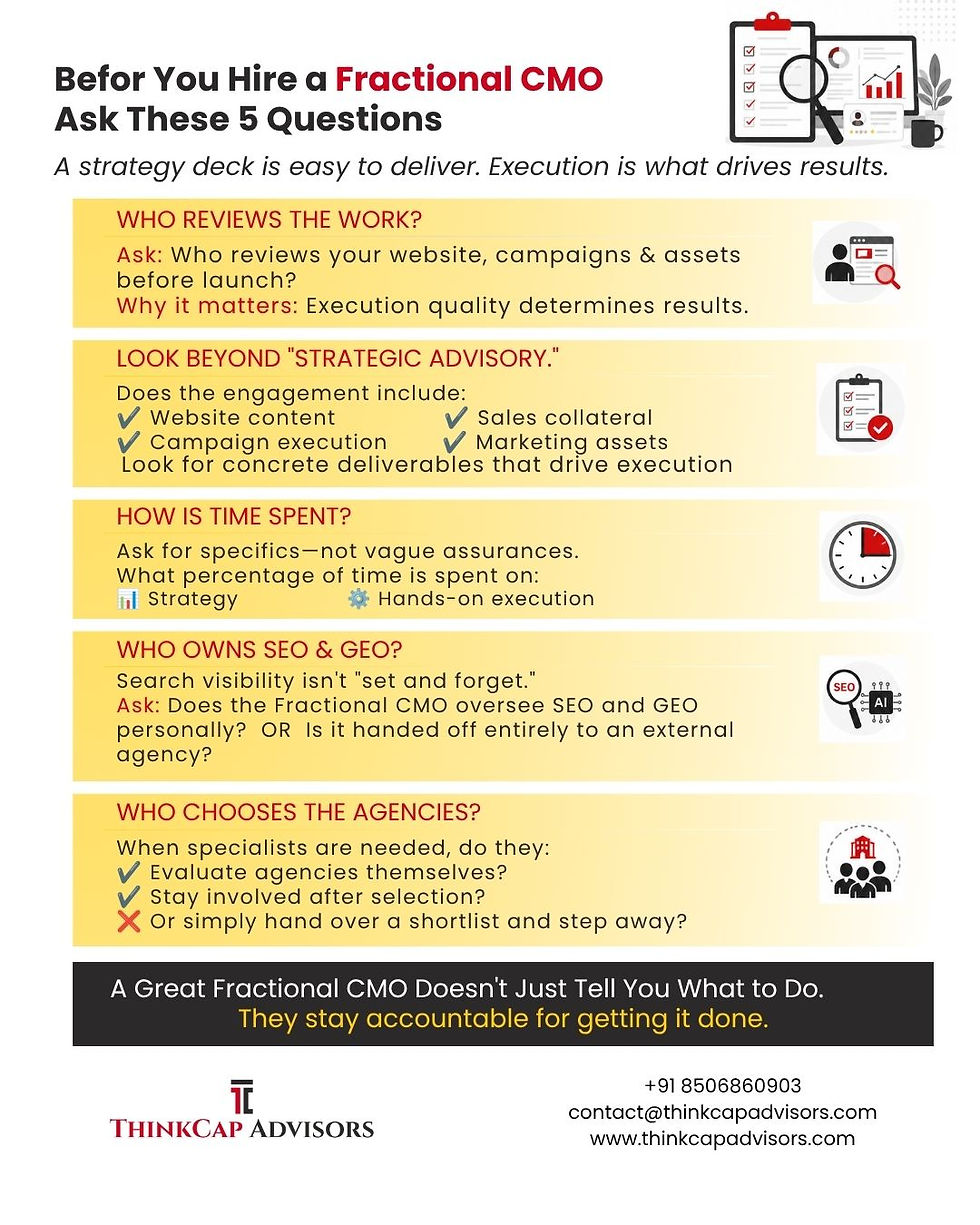
Ask who will actually review the first website page, case study, or campaign brief — not just who signs off on the strategy
Look at the scope of work: does it name concrete deliverables or only “strategic guidance” and “advisory hours”?
Ask how their time splits between strategy sessions and hands-on execution — press for a number, not a general answer
Ask who owns SEO and GEO execution day to day
Ask how agency selection works in the engagement — do they run the evaluation themselves, or hand over a shortlist and step back once you have signed
If you're still weighing whether your company needs this kind of leadership in the first place, Seven Clear Signs Your Company Needs Strategic Fractional CMO Leadership is a useful starting point.
How This Shows Up in a ThinkCap Engagement
This is the standard we hold ourselves to at ThinkCap. Our fractional CMO services aren't scoped as strategy with execution offered as an up-sell. Asset creation, channel monitoring, SEO and GEO ownership, agency evaluation, and budget management are part of the same mandate from the start. The strategy and execution sit with the same person, because that's the only way either one holds up.
The Real Measure of a Fractional CMO
Strategy answers the question of where a company should go and how it should be positioned to get there. But for most companies that engage a fractional CMO, strategy was rarely the missing piece — the ability to execute is the weak link.
A fractional CMO who treats execution core to the role is the one who actually moves the business. The value of fractional marketing leadership isn't measured by the quality of the deck. It's measured by what got built, published, ranked, hired, and spent — and whether all of it moved in the same direction the strategy pointed to.
Written By: Rahul Iyer | Lead Consultant and Fractional CMO | ThinkCap Advisors


Comments