
Utilization Certificates in CSR Compliance


For a long time, CSR funding ran on trust. A company picked an NGO it knew, released the money, and got a progress note and a few photographs in return. That is changing fast. Funding in India has moved from relationship driven giving to strict compliance and data backed impact. Companies are now expected to show where every rupee went, and to show it with papers that can stand up to an audit.
One document sits right in the middle of this shift. It is the Utilization Certificate, or UC. Most corporates see it as a form that the NGO sends at the end of a project. In reality it does much more.
It protects the company, it helps track the programme while it is running, and it decides how smoothly the next grant moves. This article explains what is a UC, why it matters, how it supports monitoring, and where NGOs and companies usually go wrong.
What is a Utilization Certificate?
A Utilization Certificate is a signed statement that tells a donor how a grant was used. In a CSR setting the company is the donor, the NGO or implementing agency is the partner, and the UC is the proof where the money was spent.
A proper UC has two parts. The first is the certificate itself, which carries the opinion of a practicing chartered accountant. The second is the statement of expenditure, which shows what was received, what was spent under each head, and what is left over. A certificate without the statement is incomplete. A statement without the certificate is only the NGO's own claim.
The accountant does not write a UC from thin air. The practitioner tests the NGO's books and checks them against backup documents such as bills, bank statements and payment records. Only then does the accountant sign. This is why the NGO has to hand over complete information. If the papers are thin, the opinion will be thin too.
The Institute of Chartered Accountants of India (ICAI) has a prescribed format for UCs. It is built to cover the situations that usually come up in CSR funding. The NGO selects the paras that apply to its case, and it should do this in consultation with the practitioner, not on its own. Two items need a separate disclosure.
One is capital expenditure, which means assets that were bought or built using the grant. The other is any surplus the project earned, such as interest on a fixed deposit or money from the sale of materials used in the project.
The CA certificate is issued to the NGO's management and not to the donor. The NGO then passes it on to the donor along with the statement of expenditure.
Is CA certification compulsory? The law does not say so in plain words. But CSR law does require every company to have a monitoring mechanism for its CSR spend, and getting the UC certified by a CA has become standard practice. A company that accepts an uncertified UC will find it hard to defend its numbers later.
Why The UC Matters More Than It Used To
There are a few reasons the UC has moved from a back-office formality to a document that senior people now ask about.
Funders want full traceability. The expectation today is 100 percent fund traceability and clear reporting. A company should be able to follow its money from the day it left the bank account to the day it was spent on the ground. The UC is the main document that closes that loop.
Rules have become tighter. Changes in the Companies Act and FCRA have increased scrutiny on how social sector money is handled. When an NGO fails to comply, the results can be serious. Bank accounts can be frozen, licenses can be cancelled, and funding partners can walk away. A company that works with such an NGO carries part of that risk.
CSR law ties the company to the NGO's paperwork. For a company, CSR spending is governed by Section 135 of the Companies Act. The company has to report what it spent and on what. If the UC from the NGO arrives late, or arrives with errors, the company's own compliance and reporting get affected. The NGO's delay becomes the company's problem.
New funding platforms ask for more disclosure. Platforms such as the Social Stock Exchange are opening fresh ways for NGOs to raise money. But they expect strong financial disclosure, good governance and independent audits. NGOs with clean UC records will find it easier to get listed. Companies that partner with them gain from the same discipline.
Good finance builds confidence. Strong financial systems build donor trust. They also open the door to larger and longer funding and make it possible to scale a programme. A well-prepared UC is one of the clearest signs that an NGO runs its money properly.
The Role Of the UC In Programme Monitoring
Many companies treat the UC as an end of project document. That wastes most of its value. Used well, it works as a concurrent monitoring tool through the life of the programme.
It compares plan with reality. Every grant starts with an approved budget, usually written into the MOU. The statement of expenditure shows actual spending against that budget. Any gap between the two becomes visible right away. If the spending does not match the approved budget, the variance has to be approved separately and in writing. This keeps the project honest and stops drift from the plan.
It gives an early warning. When UCs are prepared every quarter and not just at the end, the company sees problems while there is still time to fix them. Slow spending, a head that is overshooting, or an expense that does not belong to the project can all be caught early. Quarterly UCs should also reconcile with the year-end UC. When they do not, it usually means the NGO's books are not being kept up to date.
It supports decisions on fund release. A clean and timely UC gives the company confidence to release the next instalment. Standard UCs also help in faster fund disbursement because fewer questions come back to the NGO.
It allows comparison across projects and partners. When all NGO partners follow the same format and the same checks, the company can put numbers side by side. It can see which partner spends more on administration, which one delivers at a lower cost per beneficiary, and where the money works harder. This kind of comparison is almost impossible when every NGO sends a certificate in a different shape.
It handles ongoing and multi year projects. For projects that are still running, an interim unaudited UC can be prepared in the same expenditure statement format. For projects that run over several years, the standard format already has room to show year wise and cumulative figures. This keeps monitoring continuous and avoids a rush at the end.
It shows what is unspent. Under CSR law, money that is not used by year end cannot simply sit with the NGO. The UC makes the unspent balance visible so that it can be returned and handled the right way.
A word of caution. A UC proves that money was spent as planned. It does not prove that the programme worked. Good monitoring pairs the UC with field visits, progress data and outcome reports. Donors today also expect data backed stories and results, and the UC is the financial half of that picture.
What Different Donors Expect
Not every donor looks at a UC in the same way. NGOs that work with several funders need to understand the difference.
CSR donors. These are the compliance champions. They work under Section 135 of the Companies Act. They need accurate and audited UCs within strict timelines. They also expect the NGO to keep its own compliance active, for example its CSR 1 registration. When an NGO is late or makes mistakes, the company's internal compliance and reporting take the hit.
Institutional and foreign donors. These funders are the strict regulators. Foreign funding is tightly controlled under FCRA guidelines. The funds must be held in a separate SBI account, utilisation rules are strict, and sub granting is not allowed. There is a heavy focus on audit trails.
Philanthropic foundations. These donors offer flexible and long term funding. The statutory pressure is lower, but the expectation on impact is higher. They care about the true cost of running programmes and about system level results, and they want strong data backed stories.
The lesson is simple. A single NGO may send three kinds of reports to three kinds of donors. A clean base of records and a standard UC format makes this much easier to manage.
Staying Compliant and Audit Ready
A good UC is the result of good habits all year. Four practices make the biggest difference.
Secure the right agreements. Where possible, a grant agreement is better than a vendor agreement. A vendor type arrangement can bring unnecessary GST and TDS implications for the NGO, which eats into the money meant for the programme.
Define overheads upfront. Separate programme costs from administration costs clearly in the budget. Many NGOs under budget for the essential running costs of the organisation, and then struggle to account for them later.
Maintain continuous compliance. Keep key registrations alive, including 12A, 80G, CSR 1 and NGO Darpan. A lapse in the middle of a project can put the funding at risk.
Invest in technology. Replace manual tracking with accounting tools or an NGO ERP. These tools help track restricted funds and unrestricted funds separately, speed up reporting, and keep the books ready for audit.
Why a Standard UC Format Helps Everyone
When all practitioners apply the same checks and the NGO uses one format, both sides gain.
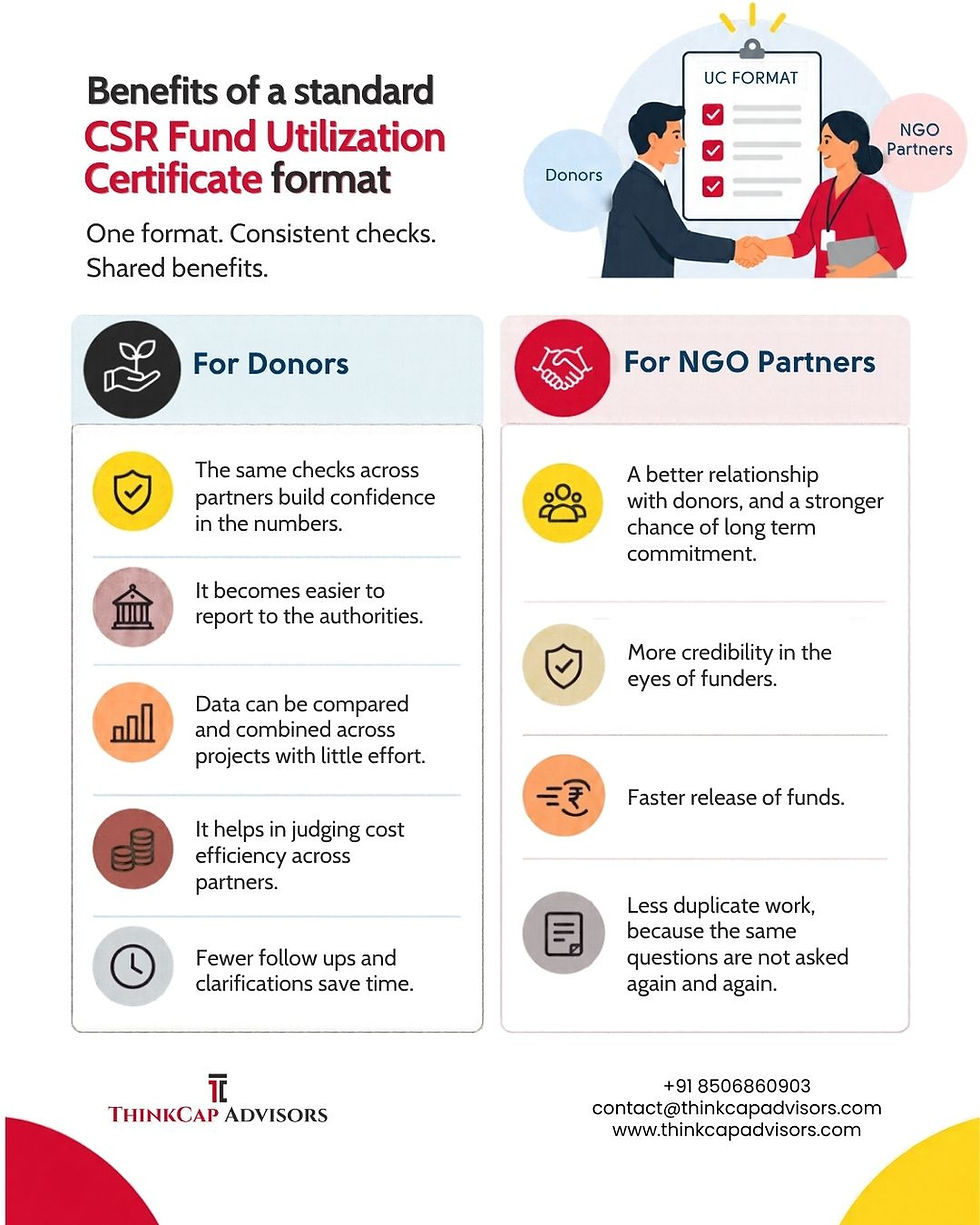
For donors, the benefits are clear.
The same checks across partners build confidence in the numbers
It becomes easier to report to the authorities
Data can be compared and combined across projects with little effort
It helps in judging cost efficiency across partners
Fewer follow ups and clarifications save time
For NGO partners, the gains are just as real.
A better relationship with donors, and a stronger chance of long term commitment
More credibility in the eyes of funders
Faster release of funds
Less duplicate work, because the same questions are not asked again and again
How To Prepare a Good Utilization Certificate
These are the habits that separate a smooth UC from a painful one.
Give complete information to the practitioner. The accountant can only test and certify what is shown. Share every record needed so the tests can be done properly.
Use the ICAI format and pick the right paras. Do not invent a new format. Select the paras that apply, after talking it through with the practitioner.
Keep project details consistent. The project name, the duration and other basic details should be the same across every UC. The signed MOU is the reference point. Small differences in names or dates raise doubts that take time to clear.
Include the right disclosures. Add a recommendatory disclosure so that the picture is complete. Capital assets and any surplus, such as interest earned or sale proceeds, must be disclosed separately.
Common Mistakes To Avoid
Most UC problems come from a short list of repeated errors. Here are the ones that come up again and again.

The declared expenditure does not match the backup documents
The declared expenditure does not follow the approved budget, and the variances were never approved separately
The format of the certificate has been changed. If the NGO and the donor disagree on the format, the NGO should talk to the donor first
The statement of expenditure is not attached to the certificate
The details in the opinion are incomplete
The CA certificate is addressed to the donor, when it should be issued to the NGO's management
Quarterly UCs do not reconcile with the UC issued at year end
There are arithmetic mistakes in the expenditure statement
One common UC is issued for several projects funded by the same donor
None of these are hard to avoid. Most can be fixed by a simple checklist and a review before the UC goes out.
What a Good Utilization Certificate Looks Like
If you want to judge a UC quickly, look for these five things.
It follows a consistent format that the donor has approved
It helps the donor with internal and external reporting
Every figure is backed by valid and complete documents
It gives the full picture of the grant
It has no errors
Building a System So Year-End is Not a Scramble
As a CSR consulting services firm advising corporates and NGOs, we have observed, the biggest cause of UC stress is leaving everything to the last month. A few steady habits fix this.
Use accounting software or an ERP to record donor related spending along with its documents. Send regular updates to the bookkeeping team so that expenses are recorded when they happen and not months later.
Try not to share one expense across several grants or donors. If a shared cost cannot be avoided, use an allocation key so that each donor bears a fair and documented share. Review the numbers every month or quarter, and write to the donor in advance if a change in budget looks likely.
Final Thoughts
The Utilization Certificate is no longer a small piece of paper at the end of a project. It is the point where the company's legal duty, the NGO's records and the community's benefit all meet. When it is done well, it saves time, builds trust and gives the company a clear view of its programmes. When it is done badly, it creates delays, doubts and compliance risk.
The good news is that the fix is not complicated. Agree on a standard format, set budgets and overheads clearly at the start, track spending through the year, keep documents ready, and involve the practitioner early.
Companies that make this a shared habit with their NGO partners will find that year end becomes calmer and that every rupee of CSR money is easier to stand behind.
Written By Dipti Iyer | Lead CSR Consultant | ThinkCap Advisors
FAQs
Is there a standard UC format that can be used for CSR projects across donors?
Yes. The format prescribed by ICAI is made for this purpose. It was created by a professional regulatory body and it covers the situations that normally arise in CSR funding. NGOs can use the same format for all their CSR donors.
What does a perfect UC contain?
It follows a consistent format that the donor has approved. It supports the donor's internal and external reporting. Every number is backed by valid and complete documents. It tells the whole story of the grant, and it has no errors.
Is CA certification required for every UC?
The law does not make it compulsory. However, CSR law does require companies to have a monitoring mechanism for CSR spend, and it is established industry practice to have the UC certified by a chartered accountant. Most companies insist on it.
How can an NGO track utilization every month or quarter and avoid year end stress?
Use an accounting tool or ERP to track donor related expenses and keep documents alongside. Give regular updates to the bookkeeping team so that spending is recorded on time. Avoid common expenses across multiple grants. Where that is not possible, use allocation keys to divide the cost.
How should small cash expenses be reported?
Petty expenses can go under a sub head called miscellaneous expenditure. If the donor wants more comfort, this head can be capped at a fixed percentage of the total grant. It is best to avoid cash expenses wherever possible.
Where should payments for services go?
Report them under the matching category of expense. For example, the audit fee should be shown under audit fee.
How do we separate material costs from administrative costs?
Use the sub heads shown in the statement of expenditure format. The format already makes this split clear.
Can payables and outstanding amounts be shown as expenditure?
No. Under CSR law, payables and outstanding amounts are not allowed as expenditure. They have to be reported as unspent.
What should we do if expenses go beyond the approved budget?
Get the donor's approval in writing before the extra spending is done. A revised budget should be approved in advance by the donor, through an email or an addendum to the MOU. Variances that were not approved will cause trouble at the time of certification.
How should interim UCs be prepared for ongoing projects?
Use the same expenditure statement format. An interim UC will be unaudited, but the layout and level of detail should match the final one. This also makes it easy to reconcile later.
How are UCs handled for multi year projects?
The standard format already captures the needs of multi year projects. Keep the reporting regular and consistent from year to year.
Can unutilized funds be carried forward? How should unspent money be reported?
Under CSR law, unutilized funds have to be deposited by the donor in a prescribed bank account. So any unused money at year end needs to be returned by the NGO to the donor. For multi year projects, the donor can release this amount again from the prescribed account in the following years. The UC should clearly show the unspent balance.
Can we issue one UC for several projects funded by the same donor?
It is better not to. Each project has its own MOU, budget and timeline. A common UC makes reconciliation hard and is listed among the mistakes to avoid. Issue a separate UC for each project.
To whom should the CA certificate be addressed?
It is issued to the NGO's management. The NGO then submits it to the donor along with the statement of expenditure.
Can the NGO change the format if the donor prefers something different?
The format should not be altered on its own. If there is a difference of opinion, the NGO should talk to the donor and agree on the approach before the certificate is issued.


Comments