
Concurrent Monitoring of CSR Activities In India


What Is Concurrent Monitoring of CSR Activities?
Concurrent monitoring — also called program monitoring — is the periodic review of a CSR project's activities while the project is still being implemented. Rather than checking on an NGO only once at the start, before the grant is disbursed, or once at the end, after the project closes, concurrent monitoring sits in between: it is the ongoing, real-time check on how a funded project is actually progressing on the ground.
In practical terms, it means a company, or its CSR consulting firm, periodically reviews the implementing NGO's activity reports, financial documentation, and progress against agreed targets — and steps in early if something is off track, rather than discovering the problem only when the project is nearly over.
How Concurrent Monitoring Differs from Pre-Grant Due Diligence
This is where many CSR teams get confused, since both processes involve “checking” the NGO. The real difference is timing and purpose.
Pre-grant due diligence happens once, before a company commits any funds. Its purpose is to establish whether the NGO is a credible, compliant, and capable partner in the first place — verifying registration documents, statutory compliance, past track record, governance structure, and financial systems.
Read our detailed breakdown of NGO due diligence for CSR compliance for how that process works. Once due diligence is cleared and the grant agreement is signed, that exercise is essentially over.
Concurrent monitoring begins only after the grant is disbursed and the project is underway. It is not a one-time credibility check — it is a recurring exercise that continues for the life of the project, typically monthly or quarterly, and asks a fundamentally different question.
Due diligence asks, “should we fund this NGO?” Concurrent monitoring asks, “is the funded project actually progressing as planned, and if not, why?”
Parameter | Pre-Grant Due Diligence | Concurrent / Program Monitoring |
Timing | Before disbursement — one-time exercise | During implementation — recurring exercise |
Core question | Should we fund this NGO? | Is the funded project progressing as planned? |
Frequency | Once, before the grant agreement | Monthly or quarterly, for the life of the project |
Focus areas | Registration, statutory compliance, governance, financial systems, track record | Activity reports, fund utilisation, progress against agreed targets, reasons for delay in project |
Typical output | Go / no-go funding decision | Course correction, timeline rescheduling, escalation if needed |
Both exercises are essential, and neither substitutes the other. A CSR consulting firm that performs only due diligence and never follows up with concurrent monitoring leaves a company unable to catch delays or execution issues until it is too late to fix them within the project timeline.
Objective of Concurrent Monitoring
The core objective of concurrent, or program, monitoring is to assess whether the project is proceeding on time, and to identify whether any specific operational, financial, or contextual challenges are arising during execution.
It also focuses on collection of data required for showcasing/reporting outcome and impact of CSR projects or for conducting impact assessment, if the project is eligible for such assessment under Rule 8(3) of CSR Rules.
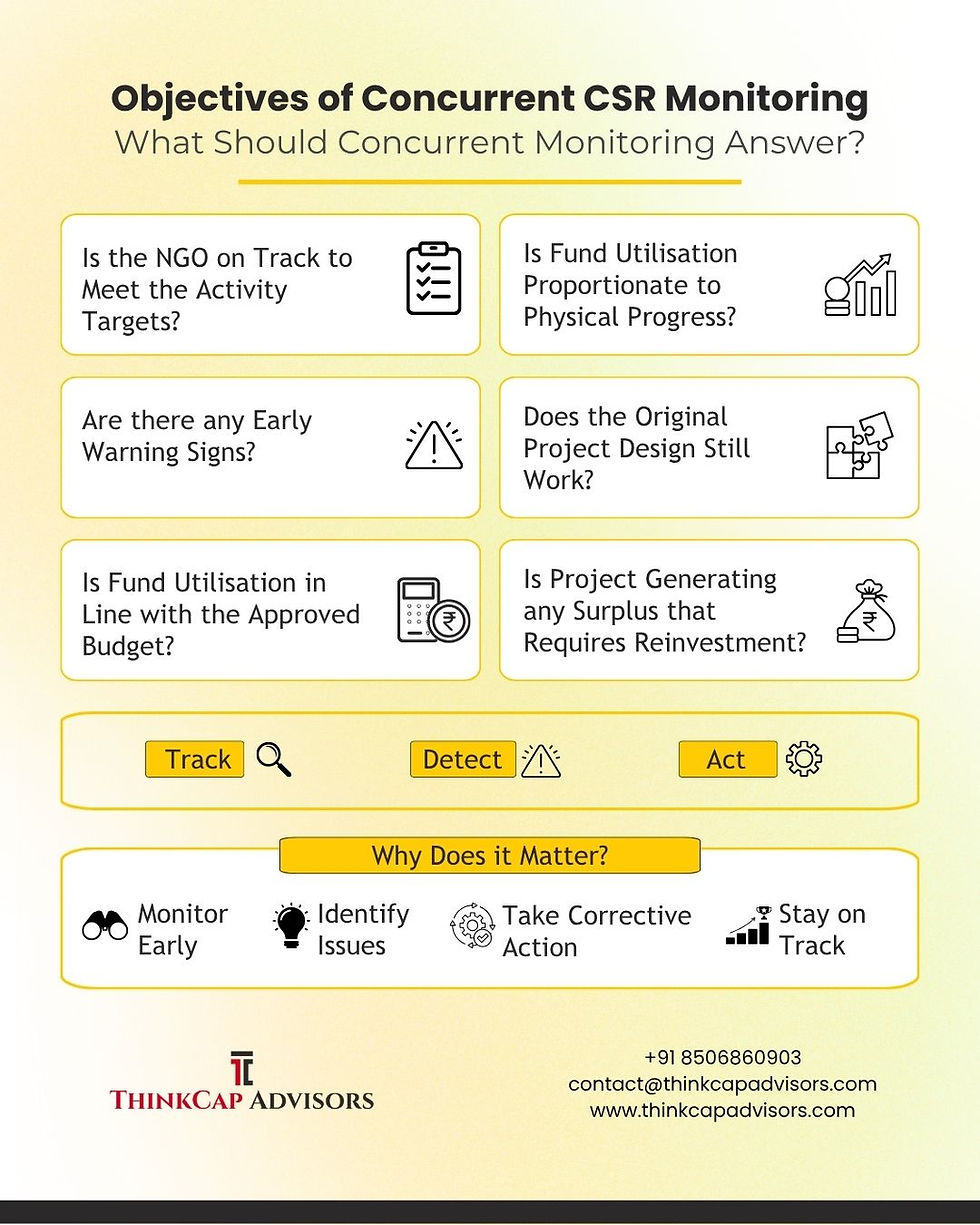
This breaks down into a few practical questions that every review should answer:
Is the NGO on track to meet the activity targets set for this reporting period?
Is fund utilisation proportionate to physical progress — is spend outpacing delivery, or the reverse?
Are there early warning signs of delay — vendor issues, staffing gaps, permission delays, seasonal disruptions, or community-level resistance?
Does the original project design still hold, or does it need to be revised?
Is the fund utilization in line with approved budget. If not, what is the percentage and reason for variance
Is the project generating any surplus that requires reinvestment in CSR projects
Getting these answers early, while the project still has runway left, is what makes concurrent monitoring valuable. Waiting until the annual impact assessment or project closure means the company only finds out what went wrong after it is too late to act on it.
Frequency: Monthly or Quarterly/Bi-annual Reviews
Program monitoring is carried out at a defined cadence — typically monthly or quarterly — depending on the project's duration, budget size, and complexity. A large, multi-year livelihood or infrastructure project may warrant monthly touch-points, while a smaller, single-location education or healthcare project might be reviewed quarterly or bi-annually.
The frequency should be fixed at the start, along with the reporting formats the NGO is expected to submit. This removes ambiguity and gives the NGO clarity on what is expected, and when.
Elements of Concurrent Monitoring
A structured monitoring cycle typically requires the NGO to submit, and the company or its consultant to review, three elements together:
Periodic activity reports — monthly or quarterly narrative updates on what activities were completed in the period, measured against what was planned. This should be backed by supporting documents such as permission letters, training curriculum/ modules, attendance or assessment records of participants etc.
Financial documents — invoices, bills, and unaudited utilisation certificates (UCs) that show how much of the sanctioned grant has been spent, and on what.
Progress against targets — a comparison of actual achievement versus the targets set for that period. This is where a Logical Framework (LFA) becomes a genuinely practical tool: the LFA layouts the project's indicators, and means of verification upfront, monitoring teams can track period-wise progress against the same matrix rather than reinventing a scorecard for every review.

Reviewing all three elements together, rather than in isolation, matters because they check each other. A report that shows full activity completion but negligible fund utilisation — or the reverse — is usually the first sign that something needs a closer look.
What Concurrent Monitoring Tracks
Beyond simply collecting reports, the substance of concurrent monitoring lies in what it tracks and how the company responds to it:
Whether the NGO is facing any challenges in respect of timing or execution — labour shortages, permission delays, monsoon disruptions, community pushback, or vendor non-performance.
Addressing challenges as they are raised, rather than simply recording them and moving on. A monitoring exercise that only notes problems without acting on them defeats its own purpose.
Asking why a project is getting delayed and how the delay can be addressed — a genuine, non-punitive conversation with the NGO, since delays are frequently driven by factors outside the NGO's control.
Rescheduling project timelines where required, and formally documenting the revised plan so both the company and the NGO are working on the same updated schedule.
This is the practical difference between monitoring-as-paperwork and monitoring-as-management. The value of concurrent monitoring lies entirely in whether the findings translate into a conversation and a corrective action, and not just a compliance file that sits unread until year-end.

Modes of Monitoring: Field Visits, Vendors, and Telephonic Check-Ins
Concurrent monitoring does not have to rely on documents alone. Companies typically combine two or three of the following modes:
Field visits by an in-house CSR team — useful for high-value or high-risk projects, and for building a direct relationship with the NGO and the community it serves.
Field visits by an outsourced monitoring vendor or CSR consulting firm — a practical option when projects are spread across multiple geographies, or when the company's internal CSR team is too small to visit every site each quarter.
Monthly telephonic check-ins with the NGO's project team — a lighter-touch option that works well between formal field visits and helps catch issues in real time rather than waiting for the next quarterly report.
Most well-run monitoring frameworks use a mix: telephonic check-ins for regular cadence, supplemented with periodic field visits for verification — especially before major fund tranches are released.
Why Concurrent Monitoring Matters for CSR Compliance in India
Under the Companies Act, 2013 and the Companies (CSR Policy) Rules, the Board is required to monitor the implementation of CSR projects and ensure that funds are utilised for the purposes for which they were sanctioned. Concurrent monitoring is the operational mechanism that lets a Board discharge this responsibility credibly, with a documented trail of activity reports, unaudited/audited UCs, and site-visit notes, rather than relying only on the NGO's own annual reporting.
Without a structured monitoring process, companies typically find out about delays or fund-utilisation issues only at year-end, alongside their annual CSR reporting — by which time there is little room to course-correct, extend timelines, or reallocate budget within the same financial year.
Periodic, structured monitoring keeps the company in a position to act while the project can still be steered, rather than only assessing what happened after the fact through a post-completion CSR impact assessment.
How ThinkCap Advisors Supports Concurrent Monitoring
As a CA-led CSR consulting services firm, ThinkCap Advisors builds concurrent monitoring frameworks that combine LFA-based tracking, periodic review of invoices and unaudited UCs, and a structured schedule of field visits or telephonic check-ins tailored to each project's scale and risk.
This sits alongside our NGO due diligence and grant audit services and our post-project impact assessment work, giving companies coverage across the entire CSR project lifecycle — from selecting the right implementation partner to verifying that the promised social outcomes were actually delivered.
As a CSR consulting firm working across sectors and geographies, we design monitoring cadences proportionate to project size — light-touch for smaller grants, more intensive for large, multi-year interventions — so that CSR consulting services genuinely add value rather than becoming another compliance formality on the file.
In Summary
Concurrent monitoring is what turns a CSR grant from a one-time transaction into an actively managed project. It complements, rather than replaces, pre-grant due diligence and post-project impact assessment — together, the three form a lifecycle of oversight that gives Boards a defensible, documented basis for their CSR monitoring obligations, and gives companies the ability to catch and correct problems while a project can still be steered.
Companies looking to set up a structured concurrent monitoring framework, or to review an existing one, can reach out to ThinkCap Advisors' CSR consulting team for a scoped engagement suited to their project portfolio.
Written By: Dipti Iyer | CSR Lead Consultant | ThinkCap Advisors
FAQS on Concurrent Monitoring of CSR Activities
What is concurrent monitoring in CSR?
Concurrent monitoring, also called program monitoring, is the periodic review of a CSR project's activities while the project is still ongoing — typically done monthly quarterly or bi-annually — to check whether the project is on schedule and whether any execution challenges need to be addressed.
How is concurrent monitoring different from CSR impact assessment?
Concurrent monitoring happens during the project and focuses on progress, timelines, and execution challenges. Impact assessment happens after the project, or a defined period after completion as required under the Companies (CSR Policy) Rules, , and measures the actual outcomes and change the project created.
Is concurrent monitoring mandatory under the Companies Act?
The Companies Act, 2013 and the CSR Rules require the Board to monitor the implementation of CSR projects, though they do not prescribe one fixed monitoring format. Concurrent monitoring is the practical mechanism most companies use to meet this monitoring obligation with a documented, defensible process.
What documents should an NGO submit during concurrent monitoring?
Typically a periodic activity report, supporting documents, financial documents such as invoices and unaudited/audited utilisation certificates, and a comparison of actual progress against the targets set out in the project's Logical Framework (LFA) or work plan.
Who conducts concurrent monitoring — the company or an external consultant?
Both models are common. Some companies use their in-house CSR team for field visits and reviews; many others engage a CSR consulting firm to conduct periodic reviews and field visits, especially where projects are large in number or spread across multiple locations.
What happens if a project is found to be delayed during monitoring?
The monitoring team discusses the reasons for the delay with the NGO, and where the delay is genuine and outside the NGO's control, the project timeline is formally rescheduled and documented, rather than the company simply penalising the NGO or withdrawing support.


Comments